Tag: American English Accent

  • Employ Power of breath to sail the voice

    Many E​nglish learners focus heavily on the articulators—tongue, jaw, mouth, lips, and throat. Yet, they still struggle to speak English naturally in various settings. A significant reason is their lack of awareness of breath control. Breath is a silent yet powerful tool for voice control, essential for smoothness, clarity, and consistency in speech.

    Breath acts as a voice carrier; however, its role is usually overlooked by learners. Many mistakenly believe that sound is created by the articulatory muscles and therefore move them excessively in pursuit of clarity. This can result in a voice that sounds “too clear” but lacks smoothness. They also overuse the articulatory muscles in an attempt to project their voice louder, but this approach often produces an unnatural and strained voice. Such habit may lead to fatigue and potential long-term harm to the articulators. Some learners, in contrast, are ​”lazy​” to move the articulators, combined with short and shallow breath, causing a weak, inconsistent and unclear voice. Additionally, some individuals sound natural when speaking alone or in small groups; however they fail to maintain effortless and consistent speech in larger, louder environments due to improper breath control.

    Having enough breath before speaking and knowing how to release it properly is crucial for voice control. Focus on breath rather than muscles. Let the breath carry the sound, and send the voice out on exhalation. You should always remind yourself to “open your throat” before speaking and maintain this openness throughout the speech. Breathing in helps open the vocal tract, position the tongue, and create more space at the back of the mouth. Once the articulators and their positions are set, maintain their stability and use breath to send the voice out. 

    First, inhale gently and slowly through the nose, avoiding aggressiveness or abruptness. Speak on exha​lation. Inhale again before starting each new phrase or sentence. Speak on exhalation. This process repeats consistently and rhythmically: inhale, then speak (on exhalation).

    Alternatively, breathe in through the mouth as if starting a small yawn. Speak at the beginning of the yawn. Do not wait until the yawn is complete as this will cause strain on the tongue root and narrow the throat and the back of the mouth.

    In addition to proper inhalation, be aware of how to breathe out effectively because sounds glide on exhalation. Sound production is closely tied to the vibration of the vocal folds. If breath is ample but the vocal folds vibrate loosely, the voice will sound breathy or hollow. Conversely, insufficient breath and tense vocal folds stress the voice, making it sound small, dull, and rigid. Remember the vocal folds regulate airflows. It’s essential to maintain their flexibility and stability to achieve a smooth, clear, and natural voice. To understand more about how the vocal folds work, check it here.

    This information may seem overwhelming at first, and practicing it can be challenging. You may have been so familiar with overusing the articulators instead of using breath to produce sound. Take time to practice, be patient, and resilient. Be attentive to the articulators, muscles, and breath. Overtime, you will become more sensitive to how these elements react and be able to gauge whether your voice sounds okay or require adjustments. Take notes on issues while practicing for review and subsequent addressing.

    In summary, effective breath control is crucial as it serves as a voice carrier​. Mastering it significantly improves vocal quality, promoting a smooth, consistent, and natural sound without straining the articulators. From my personal experience, being well-prepared with breath also greatly enhances a speaker’s demeanor—conveying relaxation, control, and full engagement in conversations.
  • Unlock American English Voice

    Greetings, English learners!

    Today, I’m going to share with you the ways to enhance your English voice, making it sound natural, effortless, yet powerful. This subject has lingered in my mind for months, but the right moment never seemed to come. Today, however, I’m feeling enough energy and motivation to delve into it, one that I’m deeply passionate about and have dedicated a countless amount of time, energy, and effort to master.

    This post doesn’t detail the specifics of the IPA chart, sound reduction, sound connection, assimilation or elision as you are likely familiar with these topics, and there are ample free resources covering them. While these aspects significantly contribute to clear and correct pronunciation, instruction on producing individual sounds isn’t my aim. The ultimate goal of this sharing is to assist you in achieving a natural, effortless, yet powerful voice in American English. For this purpose, a more comprehensive approach is necessary, involving a thorough understanding of the physical aspects of speaking American English.  

    To avoid wasting your time, kindly disregard this post if you have no concerns with your voice or no desire to reduce your native language accent or adopt a general American English accent. However, if you are grappling with any of the following issues, this post is a perfect fit, I believe, a game changer, that drastically addresses those challenges, ultimately boosting your confidence in expressing yourself with your own voice.

    English learners, this post holds the solution to the following issues:

    Voice-Identity Mismatch: You don’t hold affection for your voice and sense it doesn’t truly represent your authentic self. 

    Robotic And Rigid Voice: Despite your earnest efforts to improve your English, you find yourself unable to speak it naturally and effortlessly due to a lack of control over your articulators. There is an overuse of articulative muscles and surrounding muscles, causing restrictions and tension in the movement of the articulators. 

    Inflexible, Non-adaptive Voice: When you speak alone or in a small group, you sound fluent. However, you encounter difficulties in open spaces or crowds where louder speech is required. Your delivery becomes unclear and disjointed, primarily due to a lack of smooth and consistent transitions between pitches in your voice. The issue is rooted by the failure in maintaining stability in your articulators during speech.  

    Shallow, Flat And Weak Voice: Your voice lacks depth, energy, richness and fullness because there isn’t sufficient space inside your mouth, inadequate breath support, and a narrow or blocked vocal tract. 

    Native Language Influence: Despite your fluency with phonemes and dedicated practice of pronunciation rules such as sound reduction, connection or assimilation, your voice is still heavily influenced by your native language accent. While mastering phonemes greatly improves your English voice, understanding how the articulators function in American English speech is crucial for reducing your native accent.

    Speaking Anxiety: Though you excel in vocabulary, grammar and sentence formation, you lack confidence in your English voice. This stems from difficulties in coordinating your articulators effectively. You get stuck in identifying a right approach to speaking fluently.

    Native Speaker Listening Challenge: You have watched numerous movies, YouTube videos, or podcasts by English native speakers; however, comprehending what they say remains difficult. Apart from encountering new vocabulary, cultural aspects, or unfamiliar knowledge, the main hindrance to catching up is the lack of full understanding the physical features of American English speech, making it feel like they speak too fast.

    Slower Speech Rate: This is affected by your native languages, such as Vietnamese. Speaking American English without changing or adjusting the way the articulators work based on your native language prevents you from speaking American English at a native speaker’s speed naturally. 

    Moving forward, let’s explore the physical aspects of American English, specifically understanding how the articulators work because they are the key to address those issues. While there are numerous documents on the Internet explaining articulators, they aren’t geared towards English learners. Instead, they target individuals, both native speakers and those seeking to enhance or modify their vocal capabilities. This post, however, is designed with a focus on English learners, yet it can also provide valuable insights for native speakers facing similar challenges or for those in the transgender community.

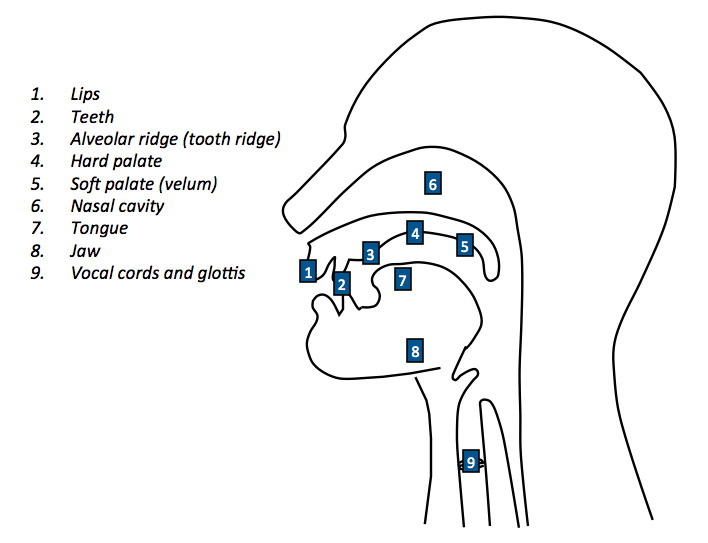
    The articulatory system shown in the picture below encompasses 1) lips, 2) teeth, 3) alveolar ridge, 4) hard palate, 5) Soft palate, 6) tongue, 7) jaw, 8) nasal cavity. In this post, rather than analyzing the features or functions of each articulator, I will concentrate on the characteristics of American English based on how these articulators work. This approach, I believe, provides a practical and solid guide for improving your voice. 

    Image source: Internet

    When speaking English, keep in mind the following key points:

    1. Open the mouth vertically rather than horizontally. Doing this will elongate your vocal tract, automatically open the back of your mouth, making your voice deeper and fuller. Horizontal mouth opening narrows the oral space, hindering the tongue’s free movement due to limited space.  

    2.  Move the jaw back and forth, not up and down. During this motion, the lower jaw slides smoothly on the hinges (TMJ) located in front of the ears. Be aware that the movement should be gentle and within a small, controlled range rather than the full extent of its motion.

    3. Position the tongue towards the front of the mouth, in proximity to the lips, teeth and alveolar ridge. This positioning facilitates easy pronunciation of consonants and ensures a smooth transition between syllables.

    4. Slightly purse the lips when speaking. This way will help maintain a vertical mouth shape.

    5. Expand the back of the mouth. Elevating the soft palate, keeping the throat open, and relaxing the neck will aid in opening up the space at the back. 

    6. The articulatory muscles should relax during speech, especially those in the tongue, neck, throat, and around the cheek areas. 

    7. The deeper breath, the louder the voice becomes. When you need a louder voice, ensure inhalation reaches deep into the diaphragm.  

    8. The vocal tract comprising the laryngeal cavity, the pharynx, and the oral cavity should be clear. Avoid blocking the vocal tract while speaking unless it is necessary. 

    Ensure your voice remains consistent for a natural, effortless, yet powerful sound. To achieve this, maintaining stability and smooth cooperation between articulators is crucial for the desired result. Regardless of the sound produced, the articulators should return to their original positions that I mentioned above after adjusting for different sounds. This secures articulator stability throughout speech.

    I hope you now have a clear understanding of the physical aspects of speaking American English. Best of luck on your practice. I would be so delighted to receive positive feedback on your progress. Feel free to ask if you have any questions about this post or English voice.